
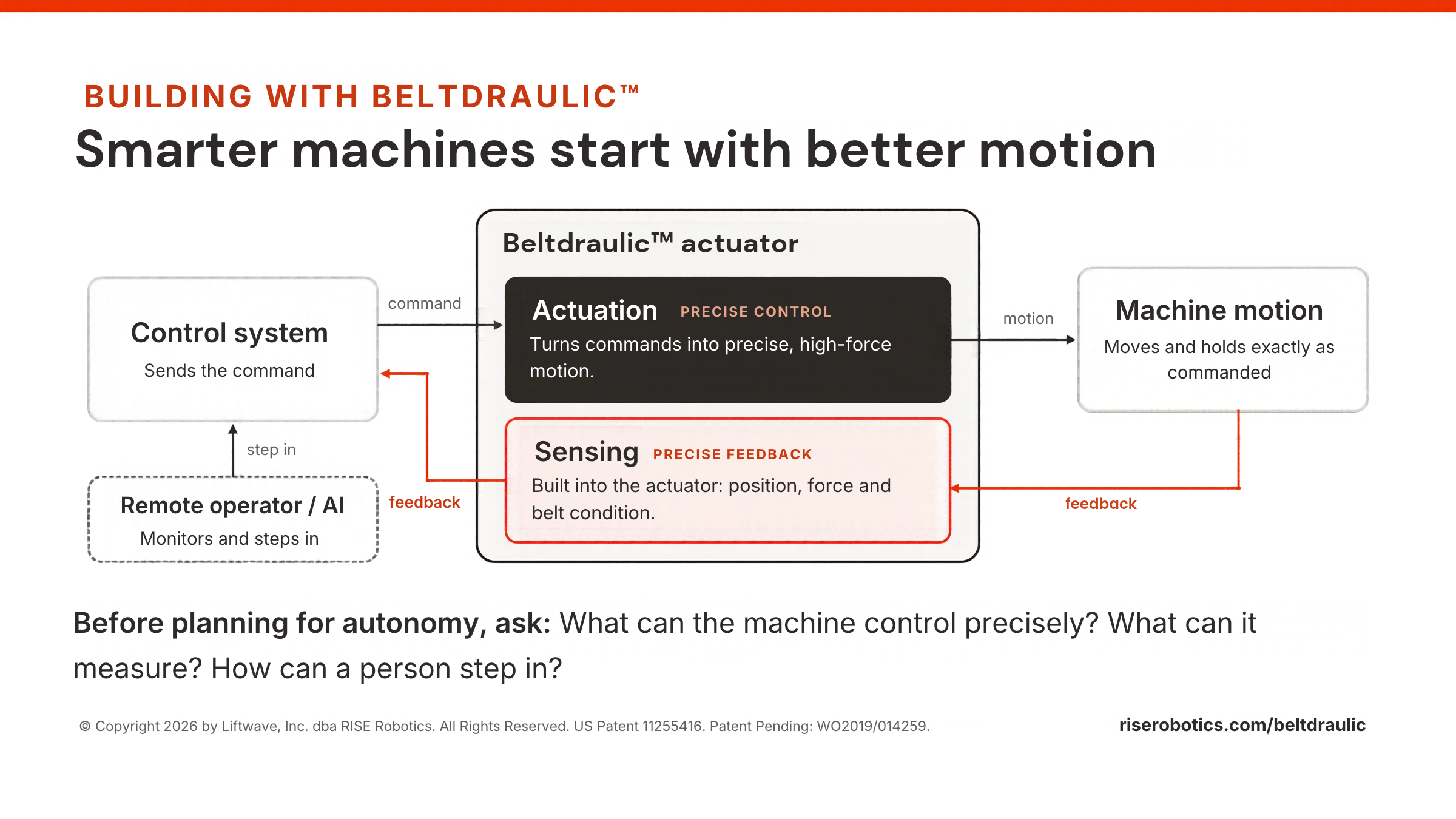
AI is moving quickly into industrial equipment, but software can only be as precise as the machine it controls. When a control system sends a command to the boom, the result depends on how faithfully the actuator turns that command into motion.
In a hydraulic system, the command passes through valves and fluid before it reaches the cylinder. Oil compresses slightly under load, hoses expand under pressure, and pressure shifts with load and temperature, so the actual movement can lag or overshoot the command. Engineers manage this with careful valve tuning and feedback, but every added layer is something software has to account for.
Closing that gap also takes sensing. To know whether a machine did what it was told, software needs reliable position and force measurements, from sensors that hold up to vibration, dirt and weather. In an electric actuator, the motor controller tracks position and current as part of normal operation, giving software a direct read on motion and load. Beltdraulic™ adds electronic monitoring of belt condition, so the system can also flag when it’s time for maintenance.
Full autonomy isn’t the first step. Electronic, drive-by-wire control lets operators run equipment remotely and take over when something unexpected happens, and that same foundation is what more advanced automation builds on. Upkeep matters too: an automated machine still needs maintenance, and removing hydraulic fluid eliminates a major source of leaks and the components that go with it.
The takeaway for equipment manufacturers: before planning for autonomy or even remote operation, ask what your machine can control precisely, what it can measure and how a person can step in.
Learn more about Beltdraulic™ → https://www.riserobotics.com/beltdraulic
